CCTV & Video Surveillance
CCTV systems, engineered for the building they protect
We design, install, commission and maintain IP video surveillance systems in Dubai — from a six-camera villa to a multi-building site with analytics, ANPR and a control room. Every system starts with a site survey and a coverage design, not a camera package. Where the premises falls under SIRA’s Preventive Systems Manual, we design to those requirements and coordinate the inspection.
- SIRA-approved for Security and Surveillance Systems Installation and Maintenance · Working on CCTV in Dubai Since 2015
Cameras are the last decision, not the first
- Most CCTV quotations in this market start with a camera count and a price. Ours starts with a question: what has to be identifiable, from where, in what light, and for how long does the recording have to survive? Answering that properly decides everything else — lens choice, mounting height, resolution, frame rate, storage capacity, network design and whether the site needs analytics at all. It is also the difference between footage that identifies a face and footage that merely shows that somebody was there.
Survey & risk
Recording & storage
Network
Coverage design
Analytics
Compliance
Cameras are the last decision, not the first
- A design is a document, not a conversation. This is what you receive before any equipment is ordered.
Site survey and risk assessment
Camera positions and fields of view
Lens and resolution selection
Lighting and night performance
Recording and storage calculation
Network and power design
Equipment and camera schedules
Drawings and technical submittals
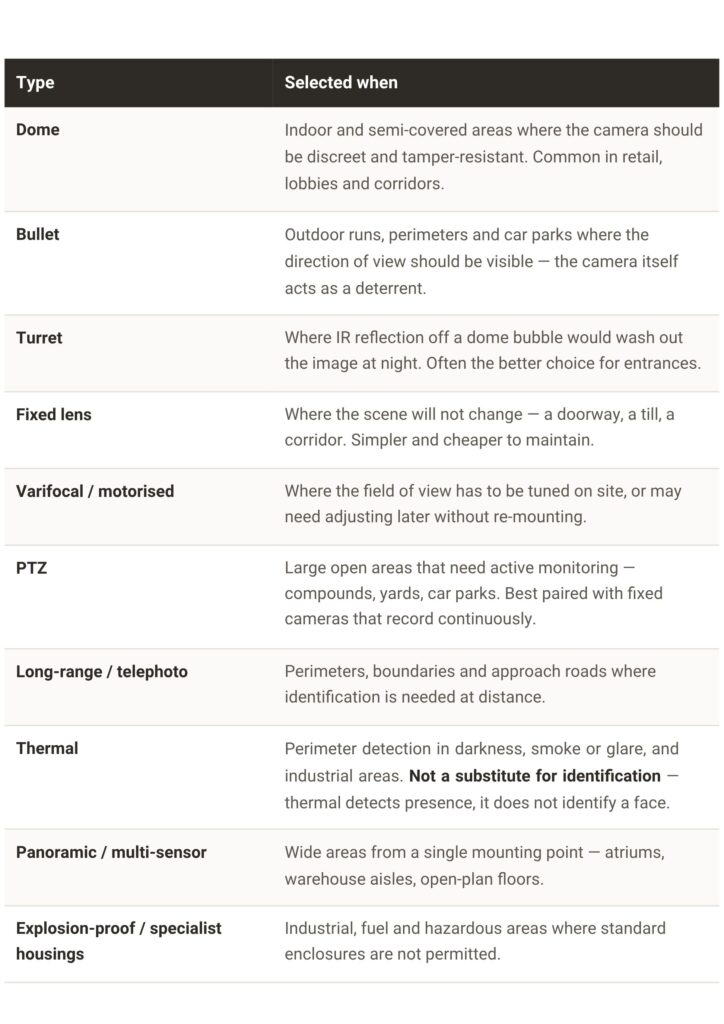
Which camera, and why
- This is not a catalogue. Each type exists to solve a different problem, and choosing the wrong one is the most common reason a system disappoints.
Analytics — what it does, and where it is worth paying for
- Modern cameras can detect events rather than simply record them. Used well, this turns a system that is reviewed after an incident into one that reports while the incident is happening. Used badly, it produces false alarms nobody trusts.
Line crossing & intrusion
Person and vehicle filtering
Loitering & unattended object
People counting & occupancy
Queue and dwell monitoring
Attribute search
Specialist surveillance systems
Reads vehicle plates at entrances and exits and matches them against a permitted list. Used on residential communities, staff and visitor car parks, warehouse yards and commercial buildings.
Integrates with: gate barriers for automatic opening, access control for combined vehicle and pedestrian entry, parking systems for occupancy and billing, and the VMS for a searchable vehicle event log.
Detects heat rather than light, so it works in complete darkness, smoke, dust and glare. Suited to perimeter detection, industrial plant and areas where lighting is impractical. It is a detection technology, not an identification technology — thermal is normally paired with a visual camera that captures the identifiable image.
Operator-controlled pan, tilt and zoom for large areas — compounds, yards, industrial sites and car parks. Configured with preset positions and patrol tours, and always paired with fixed cameras so that nothing goes unrecorded while the PTZ is looking elsewhere.
Telephoto and multi-sensor cameras covering boundaries, approach roads and open land, combined with analytics so the system reports an approach rather than simply recording it.
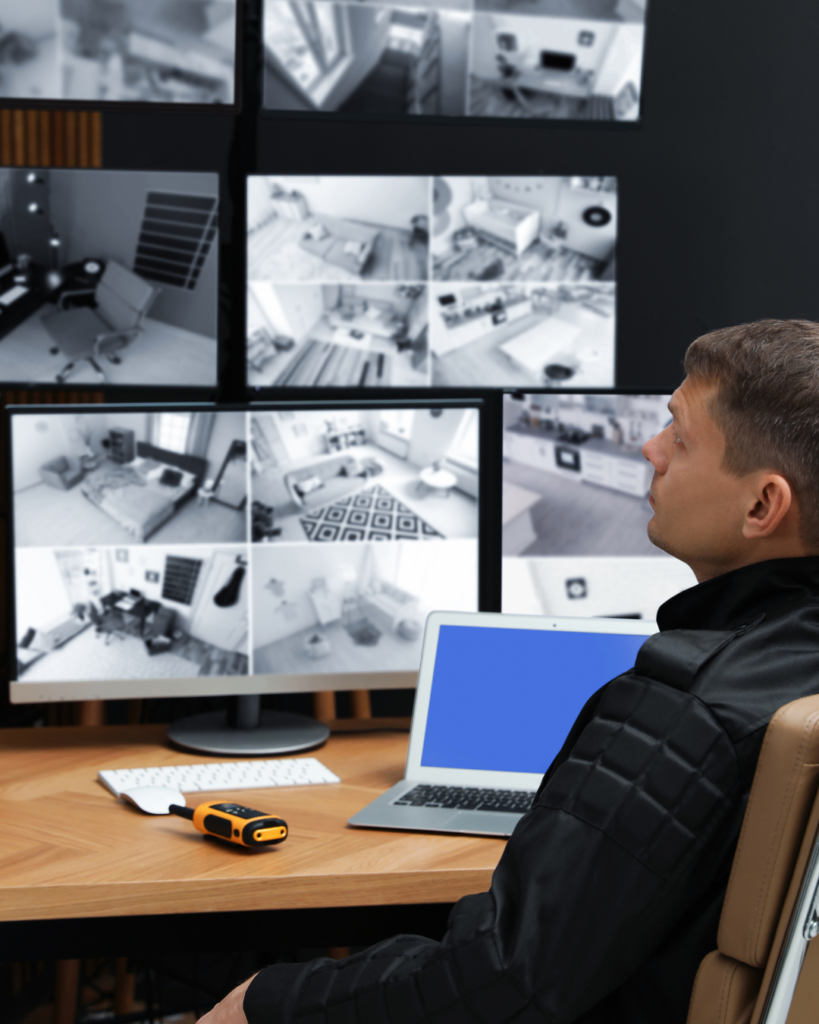
Monitoring workstations, video wall displays and operator layouts for sites where somebody is actively watching — larger buildings, communities and industrial facilities.
Recording, storage and video management
-
Modern cameras can detect events rather than simply record them. Used well, this turns a system that is reviewed after an incident into one that reports while the incident is happening. Used badly, it produces false alarms nobody trusts.
NVR or VMS — which the site needs
Users, permissions and audit
Storage architecture and resilience
Continuous and event recording
Storage calculation
Remote and mobile access
Equipment we design, supply and support
- We are a systems integrator, not a dealer for one manufacturer. The equipment is selected against the requirement and the budget — and against what is supportable in the UAE, which matters more than the specification sheet.
Volume & mainstream IP
Professional & enterprise
Video management platforms
The infrastructure behind the cameras
- We are a systems integrator, not a dealer for one manufacturer. The equipment is selected against the requirement and the budget — and against what is supportable in the UAE, which matters more than the specification sheet.
Cat6 and Cat6A cabling — tested, certified and labelled, not simply pulled
Fibre optic backbones where distance exceeds copper limits or buildings are separated
PoE switching sized with real power budget headroom, not the theoretical maximum separated
Racks, patch panels and cable management that the next engineer can readseparated
UPS provision so recording survives a power interruption
Network segregation keeping the surveillance network separate from the business network
Outdoor containment and enclosures rated for UAE heat, dust and direct sun
SIRA compliance for CCTV in Dubai
- Most commercial premises in Dubai must have a surveillance system that meets SIRA's requirements, installed by a SIRA-approved company. Private villas are usually outside it.
The current requirements come from the Preventive Systems Manual, approved by Administrative Resolution No. (13) of 2025, issued by SIRA on 14 April 2025. It applies to the establishments listed in SIRA Board of Directors Resolution No. (1) of 2018, and it supersedes earlier provisions that conflict with it.
-
Requirements set out in the Manual include a minimum camera specification of Full HD colour with continuous operation, a minimum recording retention measured in weeks rather than days, a minimum frame rate, a dedicated and resilient network for the security system, and — importantly — an annual maintenance contract with a SIRA-registered company, with a minimum number of preventive visits each year.
That last point is worth understanding: under the current Manual, maintenance is not optional. A compliant system that is not under a maintenance contract with a registered company is not a compliant system.
What we do on a SIRA project
Assess, design, plan coverage
Document, install, commission
Coordinate, hand over, maintain
Where we install
Villas, Apartments and Communities
Fit-outs and new construction
Warehouses, factories, yards
Towers and mixed-use developments
Car parks, gates and construction sites
Offices, Retail, Restaurants, Clinics
CCTV should not stand on its own
- On most projects the camera system is one part of a wider security and building package. Designed together, the parts reinforce each other. Bought separately from separate suppliers, they usually do not talk to each other at all.
Access control
Intrusion alarm
ANPR and gate barriers
Smart home and BMS
Intercom
Control rooms and video walls
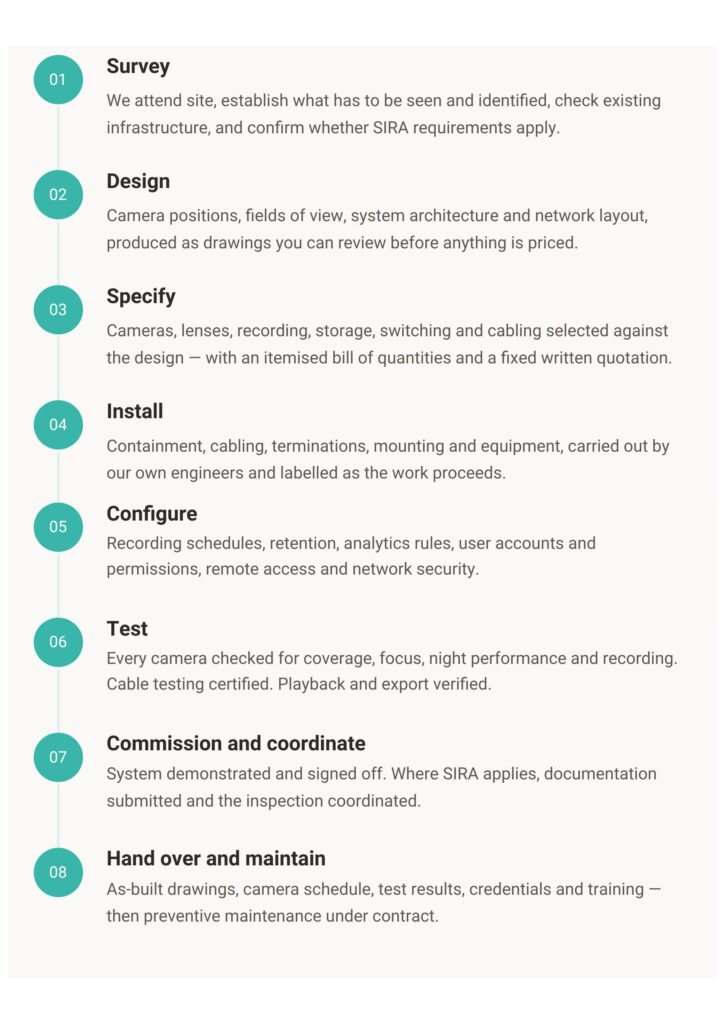
How a CCTV project runs